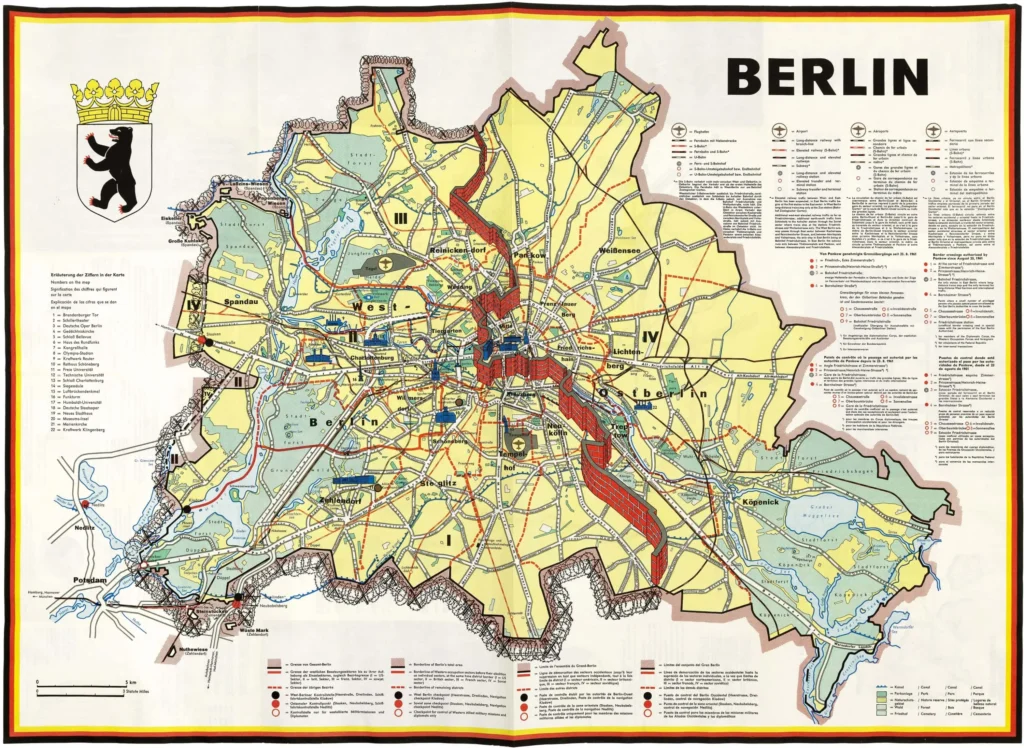
The Berlin divided map is one of the most powerful visual representations of modern history. It shows how Berlin, the capital of Germany, was split into different political zones after World War II, turning the city into a global symbol of the Cold War. By studying a Berlin separation map, readers can clearly understand how ideology, power, and geography reshaped everyday life for millions of people.
This page offers a complete, easy-to-understand explanation of the Berlin divided map, supported by historical context, clear descriptions, and SEO-friendly structure.
What Is a Berlin Divided Map?
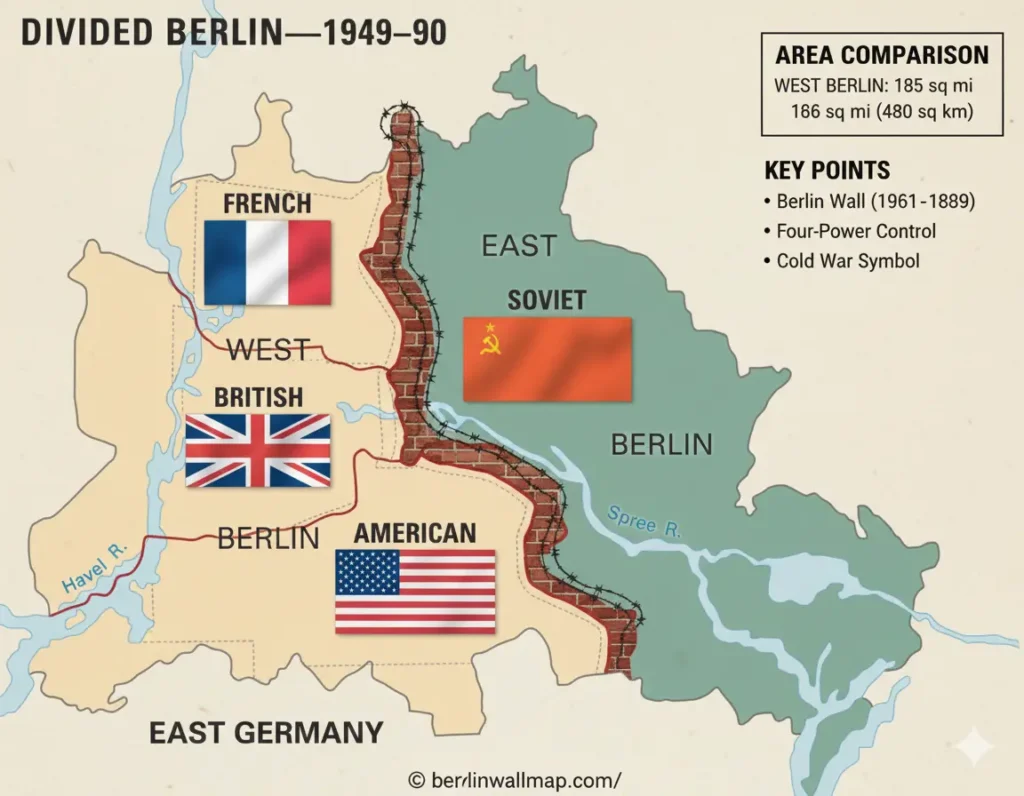
A Berlin divided map illustrates how Berlin was separated into East and West sectors following Germany’s defeat in 1945. Although Berlin was located deep inside Soviet-controlled East Germany, the city itself was divided among four Allied powers:
- Soviet Union – East Berlin
- United States – West Berlin (American sector)
- United Kingdom – West Berlin (British sector)
- France – West Berlin (French sector)
These divisions are clearly marked on a Berlin division map, usually using different colors to represent each occupying power.
Berlin Division After WWII Map Explained
A Berlin division after WWII map shows the immediate political outcome of World War II. While Germany was split into East and West, Berlin became a divided city within a divided country.
Key points shown on the map include:
- The location of East Berlin, controlled by the Soviet Union
- The isolated position of West Berlin, surrounded by East Germany
- Sector borders that later became heavily guarded boundaries
This unique geographic situation made Berlin a focal point of Cold War tension.
Berlin Separation Map and the Cold War
The Berlin separation map gained even more significance during the Cold War (1947–1991). Political differences between the communist East and capitalist West led to increasing restrictions on movement.
Important moments reflected on a Berlin divided map include:
- 1948–1949 Berlin Blockade – First major Cold War crisis
- 1961 Construction of the Berlin Wall – Physical separation of the city
- Guard towers, checkpoints, and restricted zones
Maps from this period often show the Wall cutting through streets, neighborhoods, and even buildings.
Berlin Divided Map with the Berlin Wall
After 1961, the Berlin divided map changed dramatically. The Berlin Wall became the defining feature of the city’s division.
Typical elements shown on these maps include:
- The full route of the Berlin Wall
- Famous crossing points such as Checkpoint Charlie
- “Death Strip” areas with fences and watchtowers
These maps help viewers visualize how extreme the separation truly was.
Why the Berlin Divided Map Matters Today
Even decades after reunification, the Berlin divided map remains historically important. It helps students, travelers, and history enthusiasts understand:
- How political decisions shape cities
- The real-life impact of ideological conflict
- Why Berlin became a symbol of freedom and resistance
Modern maps often overlay old division lines on today’s city, showing how history still influences Berlin’s layout.
Berlin Division Map After Reunification
Following the fall of the Berlin Wall in 1989 and German reunification in 1990, the physical barriers disappeared. However, many Berlin division maps still highlight former borders to preserve historical memory.
You may still see:
- Double rows of pavement marking the Wall’s former path
- Memorials and preserved sections
- Museums built along old division lines
Conclusion: The Meaning Behind the Berlin Divided Map
The Berlin divided map is more than a geographic tool—it is a visual story of conflict, division, and eventual unity. From the Berlin division after WWII map to Cold War-era layouts, these maps help us understand one of the most important chapters of 20th-century history.
Whether you are researching history, planning a visit, or learning for education, a Berlin divided map provides clear insight into how Berlin was once separated—and how it ultimately came back together.